Testing Stripe Payment Flows Without Live Transactions
Only webhooks reliably track order fulfillment when connections drop.
Someone pays, closes the browser tab before the redirect fires, and the order never gets marked as paid. That failure traces back to a single design mistake: treating the redirect callback as the signal that fulfillment depends on, when it was never built to carry that weight. The correct pattern routes order fulfillment through the checkout.session.completed webhook; the redirect is cosmetic, a convenience for the customer's browser, not a record of what happened on Stripe's side.
Redirect Callbacks Cannot Be the Source of Truth for Order Fulfillment
The mistake is structural, built into how the two signals work. The redirect and the webhook come from different places and travel different paths: the redirect depends on the customer's browser successfully loading a page after payment, while the webhook comes from Stripe's servers directly, independent of whatever happens to that browser tab. A dropped connection, a closed tab, a crashed mobile app, a flaky wifi network at the exact moment of redirect: any of these breaks the first signal while leaving the second fully intact. Only the webhook holds up when the connection drops, since it doesn't depend on the customer's device doing anything.
That distinction changes what a test suite needs to prove. A set of tests that only exercises the happy-path redirect, the case where the browser loads the success page and everything renders as expected, never touches the path that production actually depends on. It proves that the UI can display a confirmation screen. It proves nothing about whether an order gets fulfilled when that screen never loads, the scenario webhooks exist to handle. Any testing strategy for Stripe has to start from this asymmetry: the redirect is for people, the webhook is for systems, and only one of them is allowed to fail silently without consequence.
The PaymentIntent Lifecycle
A Stripe payment is a chain of linked objects, each one carrying identifiers that the next step depends on, and a test that pokes at just one link in that chain cannot tell you whether the chain as a whole holds together. The core hierarchy runs from Customer (prefixed cus_) to PaymentMethod (pm_) to PaymentIntent (pi_). A CheckoutSession (cs_) wraps a PaymentIntent, not the reverse, a detail that trips up more integrations than it should. Subscriptions add another layer on top: Product, Price, Subscription, and Invoice, each one generated from the one before it.
The most common integration mistake in Stripe setups comes from confusion about how Customer, PaymentMethod, and PaymentIntent relate to each other. That's exactly the kind of cross-object consistency problem a stateless mock has no way to catch, because catching it requires knowing whether the PaymentMethod attached to a PaymentIntent actually belongs to the Customer the application thinks it's charging. The IDs that matter here (stripeCustomerId, stripePriceId, subscriptionId) are what an application database should be storing. Card numbers and raw payment data should never sit in that database.
None of this unfolds in a straight line. 3D Secure authentication suspends a PaymentIntent mid-flow, after confirmation but before the payment actually completes, waiting on a customer to approve a prompt from their bank. Webhooks fire asynchronously after capture, often with enough delay that a naive test checking for immediate consistency will pass locally and fail under real network conditions. Subscription renewal generates a new Invoice and triggers a fresh payment attempt, each one capable of failing independently of whether the original subscription was ever set up correctly. A lifecycle this branched can't be verified by testing one endpoint and assuming the rest follows.
One more detail belongs in this picture, small but easy to overlook: the Stripe client should always specify an apiVersion when it's instantiated. Skipping that lets Stripe advance an integration to a newer API version with breaking changes appearing between one test run and the next, with no code change on the application side to explain why tests that passed yesterday fail today. Pinning the version is a lifecycle-integrity requirement.
What Test Card Numbers Cover
Test card numbers are the right first tool for exercising failure scenarios one at a time, but they work at the level of a single transaction, not the level of a lifecycle, and that distinction marks exactly where their usefulness runs out. Stripe's test cards cover successful payments across card brands (Visa's 4242 4242 4242 4242 among them, alongside Mastercard, Amex, Discover, UnionPay, Diners Club, JCB, co-branded Cartes Bancaires and eftpos cards, and various country-specific numbers). They cover card-level errors: declines, insufficient funds, flagged fraud signals. They cover 3D Secure and PIN authentication flows. They cover disputes, including early fraud warnings.
In API test code, the better practice uses a PaymentMethod token, something like pm_card_visa, rather than a raw card number typed into server-side code. Raw card numbers in server-side test code carry PCI risk the moment that code path gets reused, intentionally or not, anywhere near production.
The single most common integration bug, missing error handling for a declined card, is precisely what card-level test numbers exist to catch. Without that handling, a customer whose card gets declined sees a broken page instead of a clear message telling them what went wrong. That's a real and valuable thing to test, and test cards do it well.
What test cards cannot touch is anything that depends on state persisting across steps. They can't tell you whether the PaymentIntent ID created in step one is the same ID a webhook handler reads back in step three. They can't tell you whether a subscription's Invoice triggers the correct access grant for the customer who just paid. They can't tell you whether a retry using the same idempotency key returns the original result or quietly creates a second charge. Card-level state also carries across tests in ways that can contaminate results: when a test depends on card-level state, it needs its own dedicated test card, separate from any other independent end-to-end scenario, or the state left behind by one test run will bleed into the next.
Idempotency, Webhooks, and Test Clocks: The Three Lifecycle-Critical Mechanisms
Production failures in Stripe integrations trace back, almost without exception, to one of three mechanisms that card numbers never touch: idempotency under retry, webhook delivery paired with handler correctness, and the time-driven state transitions that drive subscription billing. Each one needs its own explicit test, because each one fails in a way a surface-level check won't catch.
Idempotency keys belong on every Stripe API write operation. When a network timeout forces a retry, the same key tells Stripe to return the original result instead of processing a second charge, and the key itself should be a UUID generated fresh per transaction attempt, not reused across unrelated calls. A stateless mock can't catch the failure mode that matters here: it hands back a freshly generated response on every POST request it receives, with no memory of what came before, so it will never flag retry logic that's quietly generating a new key on every attempt and creating duplicate charges as a result. Testing this correctly means using an environment that remembers the first call and returns that same result when the same key comes in again.
Webhooks carry their own failure mode. Stripe recommends separate sandboxes for local development and for CI, so automated test runs don't leave behind products, prices, customers, webhook endpoints, or settings that pollute later tests. The real test of a webhook handler is whether the handler, once the event actually fires, does what it's supposed to do: store the PaymentIntent ID from a checkout.session.completed event, update subscription access on an invoice.payment_succeeded event, and so on. A complete webhook test covers successful payment events, failed payment notifications, and the application's actual response to each one, not just confirmation that something was received.
Test clocks handle the third mechanism: time. Stripe's test clock feature simulates the forward movement of time inside a sandbox, letting subscriptions and other billing resources change status and fire webhook events the way they would months or years down the line. That makes it possible to watch how an integration handles a quarterly or annual renewal failure without actually waiting a quarter or a year for it to happen. Test clocks for v2 meter events, updated in February 2025, cut down usage aggregation delays, which made usage-based billing testing meaningfully more practical inside CI pipelines. Without this kind of time simulation, subscription lifecycle tests, trial expirations, failed renewal payments, dunning sequences, cancellations, tend to get skipped entirely or pushed off to staging environments, where they're often never run before the code reaches production.
Where Stripe's Sandbox Falls Short for CI
Stripe's sandbox remains the right reference point for business-logic accuracy: it's the closest thing to the real API's behavior that exists outside production itself. But its network dependency, its account setup requirements, and the risk of shared state between test runs leave it an incomplete foundation for a CI pipeline running on its own. These aren't flaws in the sandbox so much as architectural facts worth designing around, and Stripe's own documentation says as much directly: in a sandbox, card networks and payment providers don't actually process anything, and API calls return simulated objects. That's reliable for happy-path testing, but it's a simulation, not a live system, and every design decision downstream should start from that fact.
Rate limits apply to sandbox API calls the same way they apply to live ones. Stripe explicitly warns against using testing environments for load testing, because those limits can be hit, and a CI pipeline firing off many parallel test runs against the sandbox can get throttled by the real Stripe API in the middle of a build. Network dependency compounds the problem: sandbox tests fail in offline environments, in air-gapped CI runners, in any setup where outbound HTTPS access to Stripe is restricted, a constraint plenty of enterprise environments impose for reasons that have nothing to do with Stripe.
Stripe ships its own answer to part of this problem: stripe-mock, an HTTP server built on the Stripe API that makes no attempt to reproduce the API's actual behavior, intended for offline unit-level testing. But as a stateless mock, it can't exercise the lifecycle sequences described above, the chains of dependent objects and asynchronous events that make up a real Stripe integration.
What this points to is a gap in the CI pipeline that needs its own layer: something that provides stateful lifecycle fidelity without requiring a live network call. Not a replacement for Stripe's sandbox, but a layer that runs fast, runs offline, and never puts a CI job at risk of rate-limit throttling.
Why Stateless Mocks Fail the Create-Then-Read Test
A stateless mock can't fail a broken integration that reads from state it never stored, because the mock never had any state to read from. A mock is a mapping from request shape to response shape. It returns a hardcoded customer object when step one asks for one, and a hardcoded subscription object when step three asks for one, but any consistency between those two objects is a property of how the mock happened to be configured, not a property of the API it's standing in for.
There's a simple test that separates a mock from a genuinely stateful environment. POST a resource, GET it back, PATCH it, then GET it again: does the second response reflect the change made by the PATCH? A stateless mock returns its hardcoded response regardless of what came before it. A stateful environment tracks the mutation and reflects it.
Applied to Stripe, can the testing environment confirm that the PaymentIntent ID stored in the application database after step one is the same ID that shows up in the checkout.session.completed webhook at step three? An environment that can't answer that question can't catch the single most common webhook handler bug there is.
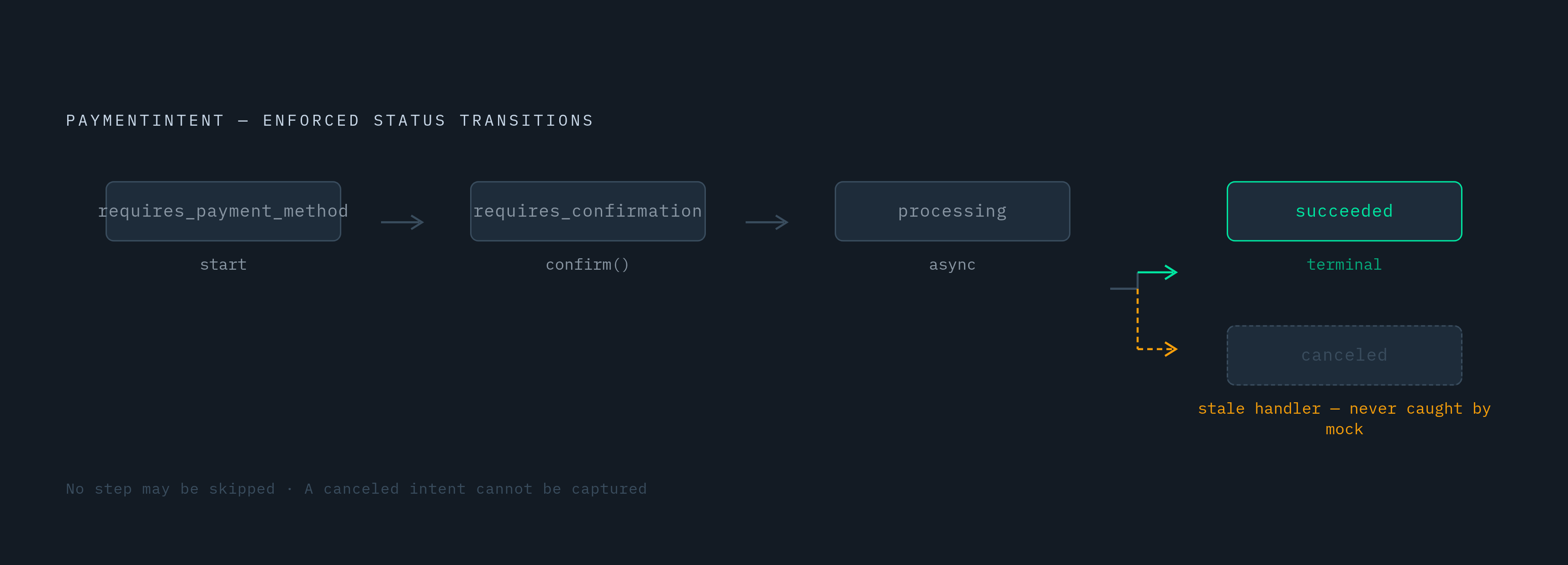
State machine enforcement matters just as much. A properly stateful environment enforces valid PaymentIntent status transitions, moving from requires_payment_method to requires_confirmation to processing to succeeded or canceled, in that order and no other. A mock has no way to flag a handler that tries to capture a PaymentIntent that's already been canceled, because a mock doesn't track status at all; it just answers whatever it's configured to answer.
A stateful simulator closes this gap by remembering state across calls, shipping with pre-seeded, realistic data, and staying continuously checked against the real Stripe API before each release goes out. That combination gives a test suite lifecycle fidelity without touching rate limits, without needing live credentials, and without requiring a network connection to run. A webhook handler reading a field the mock's canned response never included, or a retry path generating a new idempotency key instead of reusing the one it should, is enough to break the assumption that a given integration is simple enough for mocks to be fine.
A concrete testing workflow that covers the full PaymentIntent lifecycle in CI
A lifecycle-complete test suite follows the PaymentIntent through each stage it actually passes through in production, not just the stage where a card gets charged.
Stage one covers intent creation and storage. A test posts a request to create a PaymentIntent, with the amount specified in cents, a currency, metadata carrying an order_id and a user_id, and automatic_payment_methods set to enabled. The client_secret that comes back gets handed to the client, and the test asserts two things: that the PaymentIntent's ID gets stored in the application database, and that a subsequent GET request returns that same object with every field consistent with what was stored. This single stage is where the create-then-read test described earlier applies directly, and it's the stage where a stateless mock would let a broken storage path through without a single failing assertion.
From there, a complete suite extends the same discipline to every later stage: confirmation and any 3D Secure suspension that follows, the webhook firing and the handler's response to it, a retry carrying the same idempotency key, and, for subscriptions, the Invoice generated at renewal and the access grant it's supposed to trigger. Each stage asks the same underlying question the first one does: does the state the application reads back match the state it ought to have, given everything that came before it in the chain. That question, asked and answered at every link, is what separates a Stripe integration that's been tested from one that's only been demonstrated.