CI Pipelines for AI Agent Integration Test Suites
Stateful simulators checked against live APIs make agent CI gates trustworthy.
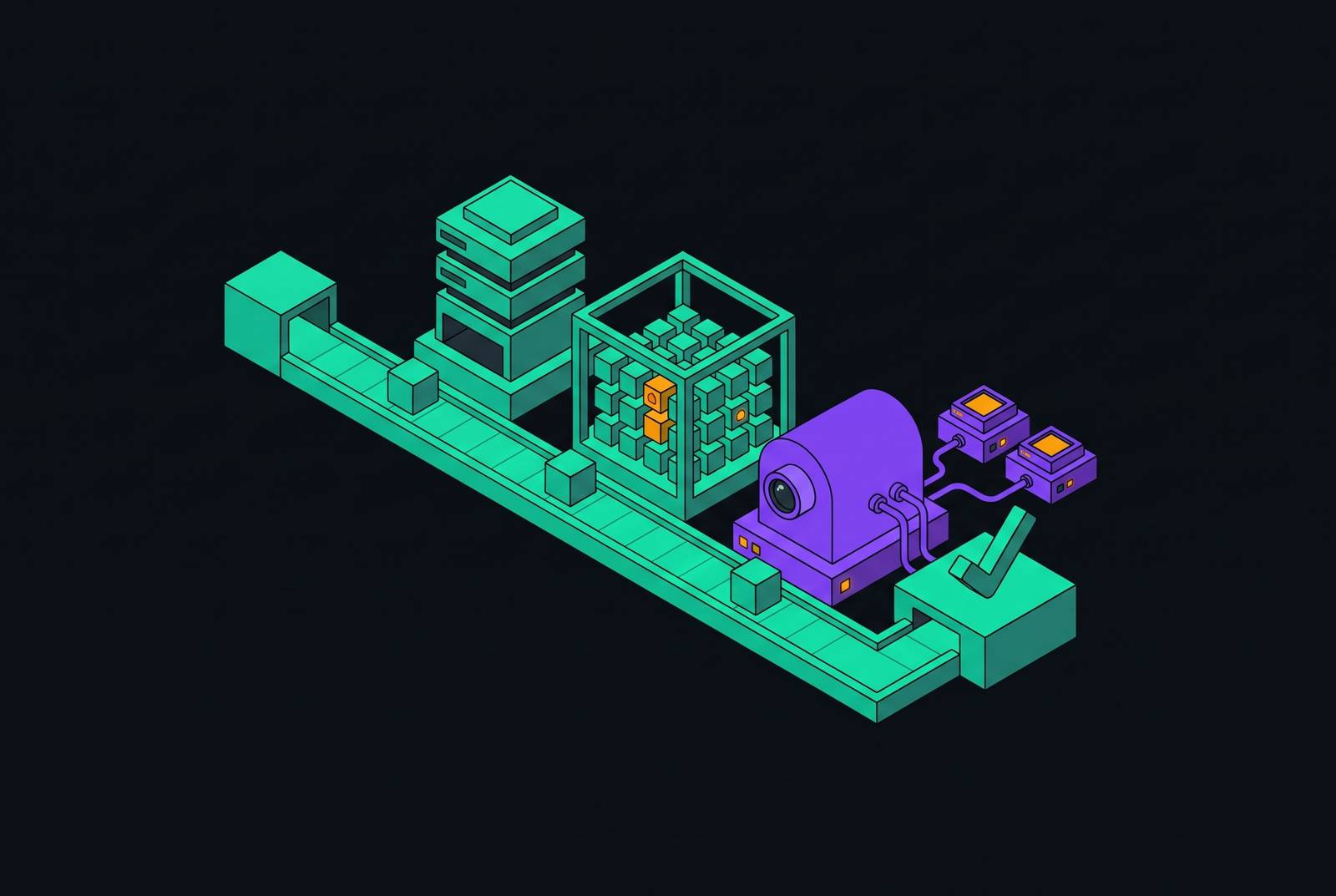
To use an API for agent evals without hitting production, run the agent against a stateful simulator continuously verified against the live API, then evaluate tool sequences, state transitions, and recovery. CI pipelines that run AI agent integration test suites need this repeatable external-API layer before model evaluation can be a gate they can trust. Live calls test whether the third party is available as well as how the agent behaves, while static fixtures cannot reproduce resource lifecycles.
Why a standard CI pipeline cannot gate on AI agent behavior
Traditional CI assumes that the same input will give an output it can predict. Agents make that assumption unreliable. An agent selects tools, interprets intermediate results, and revises its plan through decisions that can vary between runs. Exact-match assertions cannot establish whether that process was correct, and unit coverage can leave the orchestration layer untouched.
Behavior can also change without an application-code change. Model weights, prompts, and tool-response shapes can each change the workflow while unit tests still pass. Calling live APIs on every PR introduces availability and rate-limit failures, but mocking the LLM away entirely hides a different problem. A stub returning “Agent response here” never exercises dispatch, retries, state accumulation, or fallback routing. A malformed tool response at step 6 of an 8-step loop can therefore expose a bug that months of passing CI never reached. The pipeline’s job is to gate on agent behavior independently of third-party availability.
The three failure modes that only trajectory-aware tests can catch
Multi-step runs introduce three failures that final-answer checks miss. Step repetition occurs when the agent repeats an action without progress, even if it eventually finishes correctly. Reasoning-action mismatch occurs when its stated reasoning diverges from its tool call. Cascading tool errors begin with a malformed argument that corrupts later steps without making the original call look obviously wrong. Completion alone does not establish correct execution.
The five-layer evaluation framework helps locate this gap. Layer 1, tool correctness, detects misuse hidden by a passing completion score, while layer 3, trajectory coherence, examines whether the route to completion makes sense. For a refund agent, asserting that lookup_order precedes issue_refund and that delete_customer never appears is a deterministic structural check. Evaluating that recorded sequence requires neither an LLM call nor semantic scoring. Tool-inventory snapshots and release diffs complement trajectory assertions by exposing dropped parameters or renamed fields before expensive evals run.
A tiered pipeline architecture that separates cost from coverage
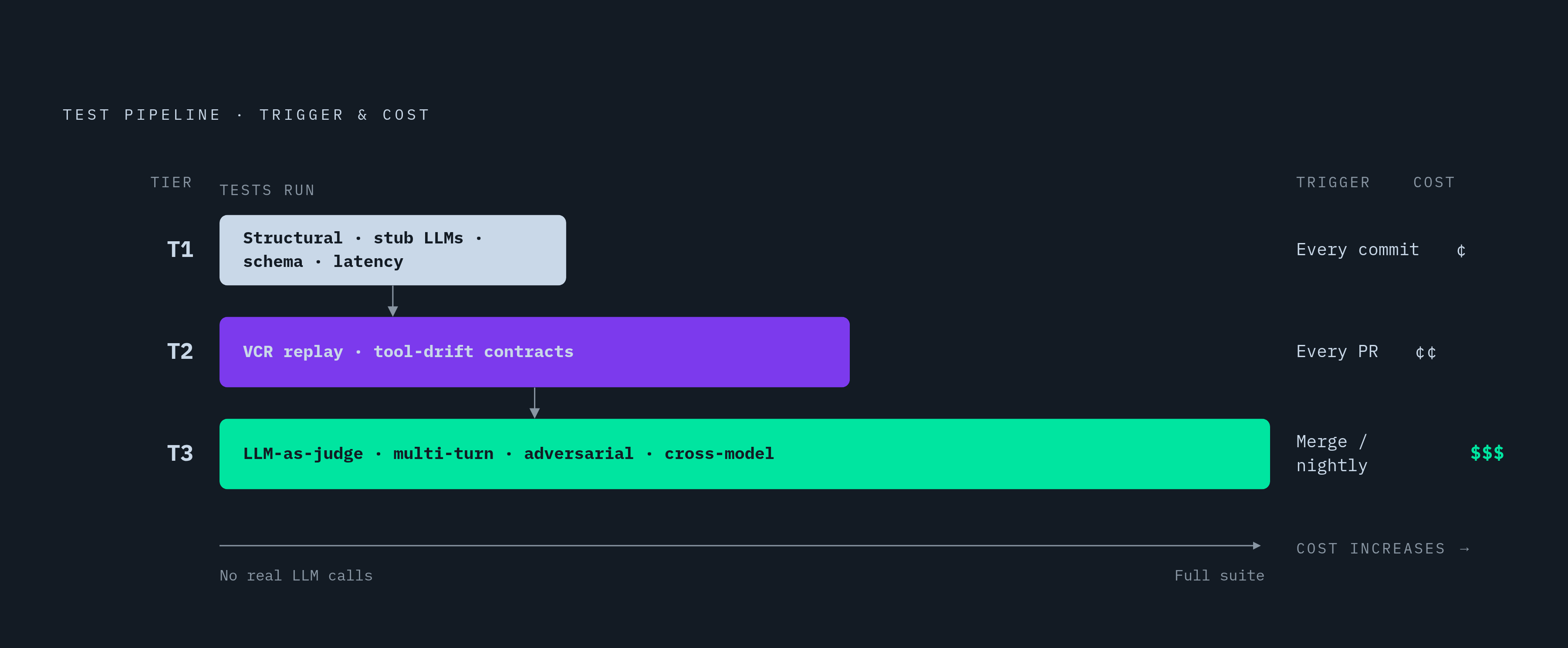
A three-tier pipeline ties the cost of tests to how often they run. Tier 1 runs structural tests with stub LLMs, schema contracts, trajectory assertions, and latency budgets on every commit. These checks need no real LLM calls. Tier 2 adds deterministic replay through VCR cassettes and tool-drift contracts on every PR. Strict request matching exposes payload changes, including unintended prompt modifications that unit tests miss.
Tier 3 runs full LLM-as-judge evaluation, multi-turn scenarios, adversarial prompts, and cross-model variants on merge to main or nightly. Its purpose is coverage that structural checks cannot provide. A smoke sample on each PR shows how the agent behaves sooner, without the cost of running the full suite. Response caching keyed on prompt hash plus model version further controls cost.
These three tiers describe execution cost under a shared definition of correctness. Each depends on an external-API layer suited to the workflow being tested. Recorded responses are useful for known interactions, but replay alone cannot establish that a newly exercised sequence of resource changes behaves correctly. That limitation becomes decisive when the agent creates something and acts on it later.
Why stateless mocks fail the external-API layer and where stateful simulators start
A stateless mock proves only a response shape. A test can mock POST /v1/payment_intents, assert 200, and pass even though the handler never stores the PaymentIntent ID. The next webhook step then reads an undefined value. The successful first call concealed the broken handoff.
An agent creates an order, polls its ID until completion, and then receives a 409 when it attempts cancellation. A fixed status fixture either ends polling immediately or never ends it. It cannot reproduce the transition into the conflict state.
Conditional mocks cover more errors that depend on the request, but they still lack persistence. Stateful simulators keep data between requests so that resources can be created, read, changed, and deleted across turns. The recommended balance is stateless testing for simple cases and deliberate stateful coverage for complex workflows, with isolated data and serial execution to prevent contamination. Scripted mocks offer more flexibility but create another backend implementation to maintain. A hand-maintained stateful mock is only as current as its last update.
Continuous verification as the difference between a simulator and a drifting mock
A simulator with persistence can still suffer from API drift. Providers can change required parameters, enum values, fields, and error codes without producing a diff in the agent’s codebase. A simulator that still behaves as it did yesterday can make today’s integration look correct. Repeatability alone is not evidence of fidelity.
Continuous automated verification against the live API before every simulator release addresses that gap. A published fidelity score makes the agreement visible rather than leaving it implicit in the implementation. Contract tests show where schemas have changed, while cassette replay can test only interactions that have already been recorded.
Vendor sandboxes serve a different purpose. Stripe test mode has vendor-specific card outcomes that a simulator cannot reproduce with the specification alone. A stateful simulator tests resource lifecycles, state transitions, and cross-service handoffs. High fidelity on stable surfaces supports using the simulator as the CI reference, while lower fidelity on changing surfaces warrants supplementary sandbox runs. Neither tool replaces the other’s distinct coverage.
What stateful simulation looks like across specific agent-relevant APIs
Stripe illustrates why webhook handling needs persistent state. When payment_intent.payment_failed fires, the agent must read the PaymentIntent, choose the retry path, and emit the appropriate downstream event. The simulator must retain that resource across delivery and the subsequent read. An isolated successful endpoint response cannot establish this.
GitHub workflows need a similarly coherent resource history. A test can open an issue, have the agent label and close it, then reopen it and check that the agent reads its updated state. Webhook retries, duplicate delivery, replay, and signature checks add event-handling coverage around that lifecycle. The updated issue must replace the cached fixture as the basis for the next decision.
Returning 200 from chat.postMessage does not establish that a message reached the correct channel in the expected state. Channel and message state make that assertion possible. In a Stripe, Slack, and Resend workflow, the test also checks that one tool’s output reaches the next tool’s input with the correct type. A 429 from Resend must not silently erase the Slack notification from the workflow.
Fault injection as a first-class CI concern, not a final-stage check
A successful happy path leaves retry and fallback behavior untested. Resilience coverage requires controlled latency, timeouts, dropped connections, malformed payloads, HTTP 4xx/5xx responses, and rate limits with retry cues. These faults belong at the simulated API endpoint. Raising RateLimitError inside an LLM stub does not exercise the same integration path.
Statefulness makes recovery testable across the fault boundary. Injecting a 429 at step 3 of a multi-step workflow should allow the test to verify that the agent resumes from its last consistent state without restarting. A stateless mock can return the error but cannot establish what survived it. The distinction is between observing a retry and validating recovery.
This pattern can be automated in three phases, startup, fault injection, and recovery. The job starts the simulator, introduces a specified fault at a specified step, and asserts the resulting state without modifying application code. With realistic pre-seeded data, these tests can cover pagination too. Small fixtures can hide failures that appear only when an agent crosses result-page boundaries.
Assembling the CI pipeline: gates, triggers, and the eval layer on top
Four gates turn the tiers into a release process. Development checks run on every commit, covering prompt linting, tool schemas, stub-driven structural tests, and trajectory assertions against the simulator. Validation runs on every PR and adds golden-dataset evaluation, drift contracts, and cross-tool handoff tests. The simulator gives both gates a stable offline API foundation, while model-dependent evaluation has its own cost controls.
Deployment promotes a versioned container with pinned prompt and model identifiers through staging on merge to main. Irreversible actions require human approval, including merges, deploys, and financial operations. Production monitoring then traces every run and turns failures into golden-dataset cases. This connects incident learning to executable coverage.
An illustrative GitHub Actions structure uses development, validation, deployment, and monitoring jobs with those triggers, plus a nightly full-evaluation job. Path filters narrow their scope. Tool changes trigger tool unit and integration tests, while prompt, planning, or model changes trigger the full scenario suite. Unrelated frontend changes skip agent evals.
The evaluation threshold should be in version control alongside the agent configuration. Validation requires evidence beyond one failed run to block score regressions beyond a defined margin relative to baseline. PII-handling and financial agents need a tighter tolerance than general-purpose agents. Reviewing threshold changes like code prevents a weakened gate from passing unnoticed.
What breaks when the simulator layer is missing and how teams typically discover it
Cassette drift occurs when recorded responses still match how an API used to behave but no longer match its current contract. The divergence becomes visible when recordings are regenerated or a new path reaches an unrecorded interaction. An empty vendor sandbox creates a different blind spot. The agent passes a simple happy path, then encounters pagination, real data volumes, and concurrent mutations outside the test environment.
Live-call suites also change character as CI traffic grows. Runs that succeed during quiet development periods begin hitting rate limits when many engineers submit PRs concurrently. Failures become nondeterministic, and reducing coverage can become the response to infrastructure noise. The agent has not necessarily regressed at all.
Live or sandbox secrets need rotation, scanning, and access-scope controls in CI. These controls do not establish the correctness of a tool sequence. Offline and air-gapped environments have an even stricter limit because they cannot use remote calls as the foundation for integration tests. A self-hosted simulator gives those environments the stateful layer they need without third-party access on every run.
Getting started: the minimum viable stateful simulator setup for a CI pipeline
A practical setup starts with one or two external APIs on the agent’s critical path. Prioritize calls where a state mismatch would cause a wrong branch or output before broadening endpoint coverage. Seed realistic data from the beginning. The first test should check a real resource lifecycle as well as whether each endpoint returns a plausible body.
Add trajectory assertions before LLM-as-judge evaluation. These checks need accurate simulation only for the calls in the tested sequence, so they provide value before the simulator covers the whole API. Next, inject the common critical-path faults, typically 429 responses and timeouts, and assert retry and fallback behavior. Expand to less common failures after those recovery paths work.
Select a simulator with automated live-API verification before every release and a published fidelity score. That evidence helps teams decide which workflows can rely on simulation and which also need vendor-sandbox coverage. The same repeatable, isolated environment also supports agent evaluation and multi-turn RL. Stateful API behavior need not require stateful execution containers, because isolated rollouts can interact with deterministic mock databases. For CI, the essential result remains a repeatable test of the agent’s decisions and their effects.