Reproducible Agent Evaluation Benchmarks With API Simulators
Stateful, verified simulators give agent benchmarks a fixed, gradable world.
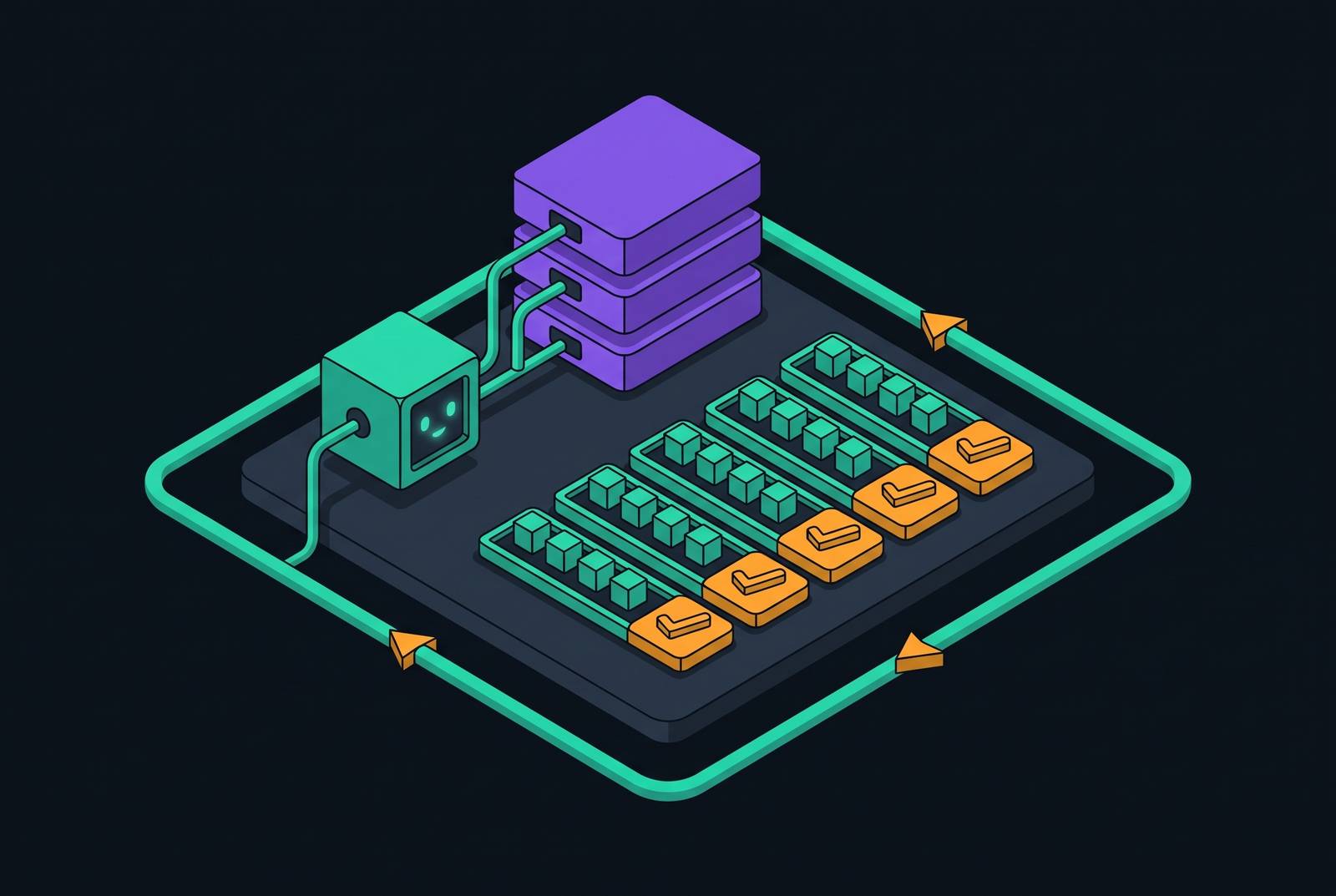
An API can support reproducible agent evaluation by routing tool calls to a stateful simulator. The simulator must keep changes across calls, start with realistic pre-seeded data, and be checked against the real API on an ongoing basis. This gives automated benchmarks a fixed world in which to grade the agent’s actions.
Why agent benchmarks need a fixed world to measure against
An agent’s non-determinism makes environmental stability essential to meaningful comparison. When account data or service behavior changes between runs, a different score cannot be attributed cleanly to the agent. Early benchmarks mostly avoided this problem by scoring final-answer text, but interactive benchmarks test whether an agent changes a system correctly. That requires control over the world in which those changes occur.
Live commercial APIs do not provide that control. AppSim-Bench (2026) documents the problem for mobile GUI agents, where recommendations, account state, and dynamic content can make the same task encounter different conditions on two devices. A shared task description is therefore not a shared test environment. The required foundation is a controlled simulation that preserves realistic interaction logic while fixing the starting conditions and service behavior across runs.
How stateless mocks fail multi-turn agent evaluation
Stateless mocks treat each API call on its own, but a multi-turn agent task depends on how the calls affect each other. Many APIs are not pure request-response functions. A resource created or changed by one call affects what a later call returns, so the response depends on both the request and the service’s history. A mock that always returns the same body breaks the chain between action, changed world, and subsequent decision.
That break also prevents meaningful outcome grading. τ-bench compares the final database state with the state a correct sequence of actions would have produced. Checking only the agent’s last message cannot implement that test, and neither can a mock that does not retain mutations. Canned responses instead bind the evaluation to the benchmark author’s anticipated sequence. When an agent takes a valid but unexpected route, those responses can diverge from what the real service would return.
The resulting error can extend beyond a single turn. CTE-Bench (NeurIPS 2026) finds that models track intervention effects reliably only when they receive correct environmental feedback. Accuracy falls sharply when earlier responses are hidden or replaced by the model’s own predictions. An evaluation environment must preserve not just plausible responses, but the causal connection between successive calls.
What stateful simulators provide that mocks cannot
A stateful simulator models a resource’s lifecycle across creation, updates, and deletion. With persistent state, later responses follow what the agent actually did, while a scripted response sequence follows a script. That difference lets a benchmark test valid paths its author did not expect, as long as those paths follow the simulated service’s behavior.
Realistic pre-seeded data gives that behavior a meaningful starting point. An empty sandbox requires the benchmark author to construct every scenario by hand and does not represent the variety of existing states an agent may encounter. Starting data is part of the test. A simulator must combine that variety with determinism, producing the same responses for the same call sequence from the same initial state. Scores can then be compared across runs, teams, and machines without depending on live credentials, rate limits, or service latency.
Persistence alone, however, does not establish fidelity. Continuous verification against the real API distinguishes a maintained simulator from a mock that merely remembers changes. Without that check, the simulation can silently return responses the service no longer produces. Controllable failures add another requirement, including injected latency, 429s, and 503s. These properties allow the environment to test both correct task execution and recovery under conditions that a live sandbox cannot reliably reproduce on demand.
How leading benchmarks converged on state-based grading
Independent benchmark efforts have converged on observable system changes as evidence of success. τ-bench’s database comparison makes the principle concrete for customer-service tasks. Agent-Diff (2026) applies state-diff-based evaluation to enterprise API tasks executed through code. The domains differ, but the grading logic aligns. An agent must produce the required state, rather than merely describe the action it intended to take.
ToolSandbox, introduced by Lu et al. in Findings of NAACL 2025, extends this principle through stateful tool execution, implicit dependencies between tools, a user simulator, and milestone-based evaluation over trajectories. AppSim-Bench applies outcome-based verification to controllable backend data for mobile GUI agents, removing major sources of environmental randomness. The resulting tasks remain demanding. Its best model completes only a slim majority, while more than a quarter are not solved by any agent.
CTE-Bench tests a related but different skill, predicting how an intervention changes the service’s later responses. It uses 255 scenarios over six deterministic Python services and grades predictions by executing the service, without an LLM judge. Replaying the unchanged service scores well across all calls but scores zero on the calls the intervention actually changes. A high score for response accuracy across all calls can hide a failure to understand a state transition.
Why environmental simulation quality sets the ceiling on what a benchmark can measure
State-based grading does not remove the need to validate the environment. A grader can compare states exactly even when the service model it uses to judge behavior is wrong. Precision alone does not establish benchmark validity. If the simulator drifts from the real API, the benchmark may reward actions that no longer have the expected production effect. The quality of the simulated world consequently limits what the score can establish.
EnvSimBench treats LLM-based environment simulation quality as a measurable research property. This separates two questions that an agent score alone cannot answer. One concerns whether the agent acted correctly, while the other concerns whether the environment responded correctly. The feedback dependence demonstrated by CTE-Bench explains why these questions cannot be collapsed. A faulty response changes the information available for the rest of the trajectory.
Behavioral verification provides a practical way to test that boundary. A curated snapshot of test cases can run against both the simulator and the live API simultaneously, allowing comparison on the same cases. A Stripe PaymentIntents emulator demonstrated this approach by achieving identical pass rates across a substantial test suite on both targets. For benchmark design, the implication is continuous re-verification before each simulator release, rather than treating fidelity as a property established permanently at build time.
What fault injection reveals about agent robustness that success-path benchmarks miss
Clean responses reveal whether an agent can finish a task when tools cooperate, but not whether it recognizes that a tool has failed. Agents may proceed after an error as though valid results arrived, fabricating data to fill the expected response shape. Success-path tests leave this failure invisible. Fault injection makes the agent’s treatment of unsuccessful calls observable.
Placement is as important as fault type. An early fault can collapse an entire trajectory, while the same fault later may have no measurable effect. A useful environment must therefore inject failures at arbitrary points in a stateful call sequence. Architectural sophistication is not a reliable substitute for this testing. Fault research finds that simpler agent architectures can outperform more sophisticated ones under stress because self-reflection mechanisms intended to support recovery can instead amplify the disruption.
A downstream API may time out while the LLM is already running slowly, producing conditions that isolated fault tests do not cover. Concurrent or cascading fault injection extends evaluation to those compound failures. The benchmark requirement follows directly from that gap. Latency spikes, 429s, and 503s must be first-class simulation controls if the resulting score is intended to describe production-relevant robustness.
How stateful simulators serve RL training environments as well as evaluation benchmarks
The properties required for reproducible evaluation also support reinforcement learning for tool-using agents. Training requires thousands of episodes in parallel, each with its own isolated world state. Live APIs impose rate limits, shared state, and costs that make this impractical at training scale. Isolation is therefore a training requirement as well. A simulator that scales horizontally across containers, retains independent state per episode, and resets cleanly between episodes makes external-tool training tractable.
The grading mechanism can transfer into the reward signal. τ-bench implements state-diff grading through reads and writes over a small database. In a training environment, an episode that reaches the correct database state can receive a reward using the same observable outcome. The simulator makes that outcome reproducible. Determinism and controllable faults also retain their role, allowing episodes to run against defined conditions insulated from uncontrolled live-service changes.
The IBM/Yale agent evaluation survey identifies scalable, fine-grained evaluation as a critical gap for the field. Closing that gap also calls for better simulation quality, because an environment that gives wrong feedback still does so when it scales. EnvSimBench covers 400 samples across 167 diverse environments, with verifiable labels and difficulty stratification. Its treatment of simulation as a separate research problem reflects this broader infrastructure role. The environment that supports a reproducible benchmark can also support training, but only if its state updates and feedback remain dependable.
How do you test an AI agent against realistic API responses without hitting production?
A benchmark setup ready for production sends the agent’s API calls through a local stateful simulator that starts and stops cleanly for each CI run. It must handle the full realistic sequence, including creation, mutation, webhooks, retries, and errors. Happy-path response coverage is not enough. The test needs those interactions to work together throughout the task, with realistic starting data and changes kept for the grader to check.
Local execution removes the live-service dependencies that destabilize CI. Production calls can hit rate limits, incur costs, and perform irreversible operations such as sending emails or writing records that contaminate subsequent runs. Network latency adds another uncontrolled source of variation. A local simulator avoids those effects while allowing latency to be introduced deliberately as a test condition. Clean setup and teardown keep a run from starting with state left over from the last run.
The recommended staging places offline simulation first, before deployment or contact with a live environment. This phase covers known tasks, fault injection, and tool-error chaos so that regressions are detected before the agent acts against a live service. Outcome grading remains central to that gate.
Slack, GitHub, Stripe, Kalshi, PayPal, Resend, and Lob each have their own state models, rate-limit behavior, and failure modes. Supporting an API name is not sufficient. The relevant standard is whether the simulator reproduces the call sequences and state transitions the benchmark exercises, with fidelity re-verified before each release. That makes the simulator’s tested behavioral coverage, rather than its endpoint count alone, a concrete criterion for a production evaluation setup.