Test Pyramid Breakdown for API-Dependent Services
How external APIs break the test pyramid's core assumptions.

The test pyramid's basic cost argument still holds: unit tests are cheap and precise, integration tests cost more to write and run, and end-to-end tests are slow and brittle, so the smart move is to build mostly the cheap ones and keep the expensive ones to a minimum. That logic was built for a world where most of what a program did happened inside a single deployable unit, with a database and maybe a file system as its main outside contact points. External API dependencies break that world in three specific places.
The first break hits unit isolation. When a serverless function or a microservice exists mainly to call an external API, such as a payments provider or a messaging platform, there is no "unit" of logic left to test that stands apart from that API's contract. The second break hits integration stability. The pyramid assumes an integration test runs against something local and controlled, but a live third-party API brings rate limits, credential handling, and network variance that no local test ever had to deal with. The third break hits end-to-end scope. The pyramid treats an E2E test as broad but still bounded by the system under test, yet once several external APIs sit in the critical path, a single E2E run can fail for reasons that have nothing to do with the team's own code.
None of this means the pyramid's shape is wrong. The discipline it encodes, catch each failure at the cheapest layer that can catch it, still applies. What changes is which layer counts as cheap once external APIs enter the picture, and that shift is what the rest of this piece works through, layer by layer.
Loose mocking at the unit layer and the false sense of security it creates
A unit test that mocks an external API is only as good as whoever wrote the mock understood that API on the day they wrote it, and that understanding starts going stale the moment the real API changes. A mock, in practice, is a static lookup: given this path and this body, return that response. It has no memory and no sense of sequence. Ask it whether the customer created in step one still exists by step three: it can't answer honestly, because it returned a hardcoded object in step one and a separate hardcoded object in step three. Any consistency between them is just whatever the test author typed in, not a reflection of how the real API behaves.
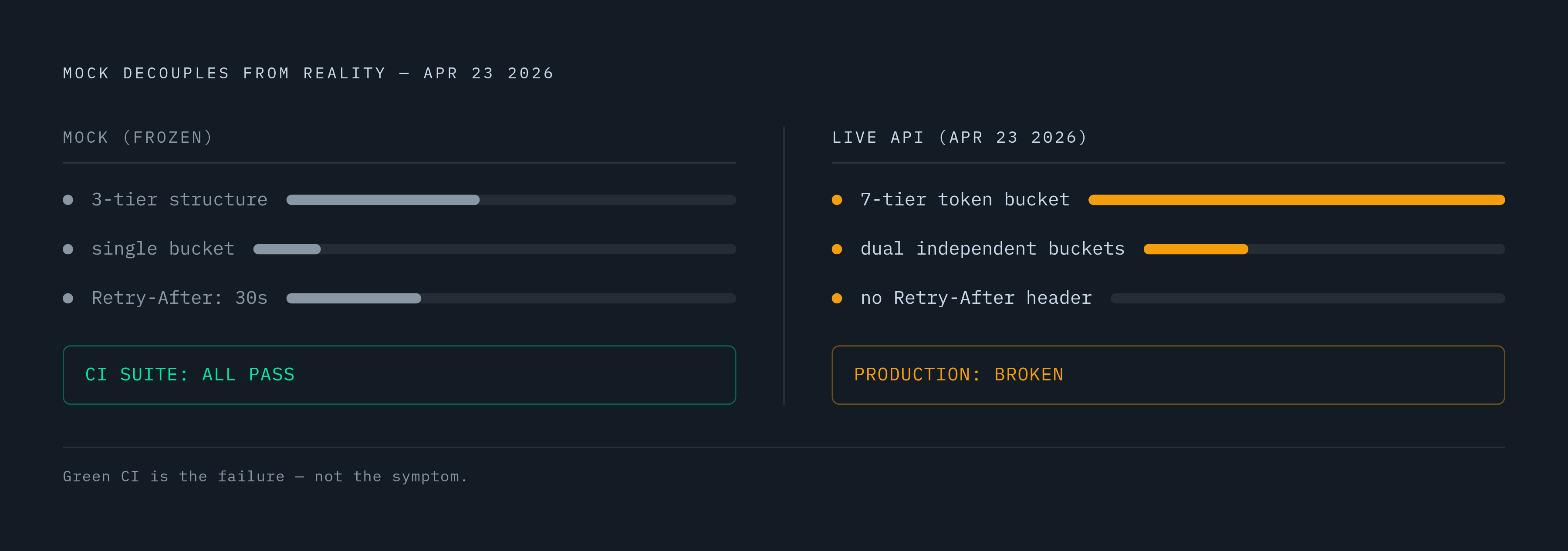
Kalshi's rate-limit system is a useful case to think through here, because of how much it changed in one move. On April 23, 2026, Kalshi switched from whatever simpler scheme it used before to a token-bucket model with seven tiers, Basic through Prestige, each with two independent buckets and no Retry-After header to tell a caller when to retry. A mock written against the old behavior keeps returning whatever responses it was configured to return, with no way to reflect the new tier structure, the dual-bucket accounting, or the fact that there's no longer a standard header telling the caller how long to back off. The test suite stays green. The code that handles rate-limit responses, written and tested against the old assumptions, has no way of knowing anything changed.
This is the shape of the over-mocking trap: mocked tests pass locally, and the system still breaks in production, because the mock matched what the developer expected the API to do rather than what the API actually does on a given day. That's circular by construction. The test confirms the assumption it was built on, not the API's real behavior, so a passing suite tells the team nothing about whether the integration will hold. Hand-maintained mocks need a manual update every time the real API changes; a drifted mock is typically caught only in production, since no stage in the pipeline checked it against the live service. None of this is an argument against mocking. Mocks remain the right tool for pure business logic and internal error-handling paths, where speed and precision matter less for fidelity to an external contract and more for how quickly and precisely the logic can be checked. The mistake is asking a mock to stand in for integration confidence it was never built to provide, when response shapes, error codes, and state transitions need checking against the real service.
The integration layer's collapse under live credentials and real API calls
An integration test that calls a live third-party API is an experiment whose outcome depends on network conditions, the current rate-limit state, whether the credentials still work, and whether the provider happens to be having a good day. That dependency produces four distinct failure modes, each one predictable in hindsight and each one capable of taking down a CI run that has nothing wrong with the code it's supposed to be testing.
Rate limits come first. A CI pipeline usually shares its API quota with developer activity and sometimes production traffic, so a test run that passes at 9 a.m. can fail at 2 p.m. using the exact same code, because the same credentials already used up the allowance. Kalshi's move to seven tiers with two independent buckets per tier, and no Retry-After header to signal when it's safe to try again, makes this failure mode harder to diagnose: a failing test now has to be debugged against a quota system with more moving parts and less built-in guidance about what to do next.
Credential management is the second failure mode. Static API keys sitting in CI configuration are a standing security risk, and even moving to short-lived tokens doesn't remove the cost, it just relocates it: every additional external service in the test suite adds its own rotation, storage, and expiry logic to maintain. Network variance is the third. A test that calls a live API inherits that API's latency, its regional routing, and its occasional transient failures, none of which have anything to do with the code under test, and all of which erode developer trust in a suite that fails for reasons nobody can explain.
The fourth failure mode is a gap between sandbox and production that's easy to overlook until it bites. Stripe's own documentation states that payments made in a sandbox are not processed by real card networks or payment providers. A green run in sandbox confirms that the code called the right endpoints with the right shapes. It does not confirm that the same code will behave correctly against real card networks in production, and that gap is exactly where integration risk hides.
Webhooks make this concrete. A real Stripe integration puts a substantial share of its logic in webhook handlers, code that only runs when Stripe tells it a resource changed. A live sandbox fires those events when something mutates, but a stateless mock has no mechanism to fire anything, because there's no event system behind it, only a static response table. Stripe retries undelivered webhooks for up to three days; PayPal requires an HTTP 2xx acknowledgment and also retries failed deliveries multiple times over a three-day window. Testing that retry and acknowledgment logic against a live sandbox means either waiting out real multi-day retry windows or manually forcing them, and neither option fits inside a CI gate that needs an answer in minutes.
Faced with this, teams tend to land in one of two losing positions: skip integration tests in CI and accept the coverage gap, or run them against live APIs and accept the flakiness and the credential exposure that comes with it. Neither is acceptable given what's at stake, because the API and contract layer carries the largest share of defect-prevention value in a distributed system. That's the layer where accepting flakiness or skipping coverage costs the most.
What stateful, verified simulation provides at the integration layer
The integration layer works once its stand-in for the external API remembers state across calls and gets checked against the real API on an ongoing basis. Those two properties remove the two root causes of integration test failure described above: a stand-in with no memory, and a stand-in that quietly drifts from reality. "Stateful" is the more concrete of the two to picture. A stub that returns the same order object every time something calls GET /orders/42 can't express the flow integration tests actually need to check: create an order, fetch it, cancel it, then fetch it once more and see a status different from the first fetch. A stateful simulator maintains cumulative state across calls, so when a test adds a record in step one, the simulator still remembers it in step three, unlike a stateless mock that has already forgotten by the time step three runs. The same mechanism extends to webhooks: when a resource mutates inside the simulator, the simulator can fire the corresponding event to the webhook handler, something a stateless mock has no way to do.
"Verified" addresses the drift problem. A simulator that nobody checks against the live API will drift just as a hand-maintained mock drifts, only slower, and it will hand developers the same false confidence while taking longer to show that it's wrong. Verification means running the simulator's own contract suite against the real API before every release, so that when a provider changes its behavior, that release check catches the mismatch instead of a customer's production incident catching it. Platforms built this way can publish fidelity scores that make the comparison auditable: a team can see exactly where the simulator and the live API agree and where they don't.
Rystic is one platform built around this approach, running locally as a stand-in for the external APIs a service depends on. Its simulators maintain state the way a stateless mock cannot, and they're checked against the live API before each release, so that check catches drift between simulator and reality before it ever reaches production. A team working against a service like this runs integration tests against a faithful replica with no rate limits to hit, no credentials to rotate, and no network variance to explain away, the kind of controlled, repeatable environment the integration layer was supposed to have from the start.
The whole point of the pyramid was to catch failures at the cheapest layer that could catch them. Stateful, verified simulation makes the integration layer fast, local, and free of credentials and rate limits, so it can carry the load the pyramid always expected it to carry, without the flakiness that otherwise pushes teams toward skipping it or leaning too hard on E2E tests to compensate. For a service where the primary action is calling an external API, a verified stateful simulator lets a team push integration-grade confidence, the kind that actually confirms the code handles real API behavior correctly, down into the layer where it's cheapest and fastest to catch problems. That's what makes the API and contract layer a sound base for a modern distributed-systems test portfolio: the tests sitting there have to be fast and reliable for the economics to work, and simulation of this kind is what makes that possible.
Rate limits and environment complexity in E2E tests for distributed systems
End-to-end tests in API-dependent systems fail because every external API sitting in the critical path adds its own independent source of unpredictability, and each one multiplies the odds that a given run produces a false failure that has nothing to do with the code being tested. Every external integration an E2E test touches, a third-party API, a legacy system a company hasn't modernized yet, has to be either included live or simulated; there's no third option. A shared staging environment that calls live external APIs builds up quota usage from every test run, every developer poking at it, and any other traffic riding the same credentials, so quota exhaustion ends up being a function of team size and how often people run tests, not a function of whether the code under test is correct.
Flakiness at this layer has a different character than flakiness at the unit or integration layers. A failing unit test usually points to a narrow enough scope that someone can track down the cause quickly. A failing E2E test tells the team something broke somewhere in a long chain, without saying where or why, and every external API added to that chain is one more failure domain the team can't instrument or control from the inside. Once developers can no longer tell a genuine regression apart from a rate-limit hit or a transient failure on someone else's infrastructure, they stop trusting the suite, and a test suite nobody trusts is a test suite nobody reads.
None of this argues for dropping E2E tests. It argues for being precise about what they're for. E2E tests still do something unit and integration tests can't: they confirm that all the services in a system work together through real user journeys, and they catch regressions that only show up at the boundaries between services. What they shouldn't be is the main line of defense for API contract behavior, since that job belongs at the integration layer and carries far more cost when handled at the E2E layer instead. The right scope for E2E tests is the small set of journeys where a bug means lost revenue or lost users, nothing broader. Running those tests against stateful simulators for the external dependencies removes the rate-limit noise and the credential exposure while still exercising the real integration logic along the way, so the critical path gets verified without the unrelated noise riding along with it.
Without that discipline, teams move the tests out of the pull-request gate and into a nightly job, or drop them from the pipeline altogether; this is the common failure pattern seen across teams that can't make E2E tests reliable against live APIs. What's left is an inverted pyramid, real gaps in integration coverage, no dependable E2E gate standing in front of release, and production quietly functioning as the team's actual test environment.