Hermetic Test Environments for Backend Services
Isolate backend tests with local stateful simulators instead of shared staging environments.
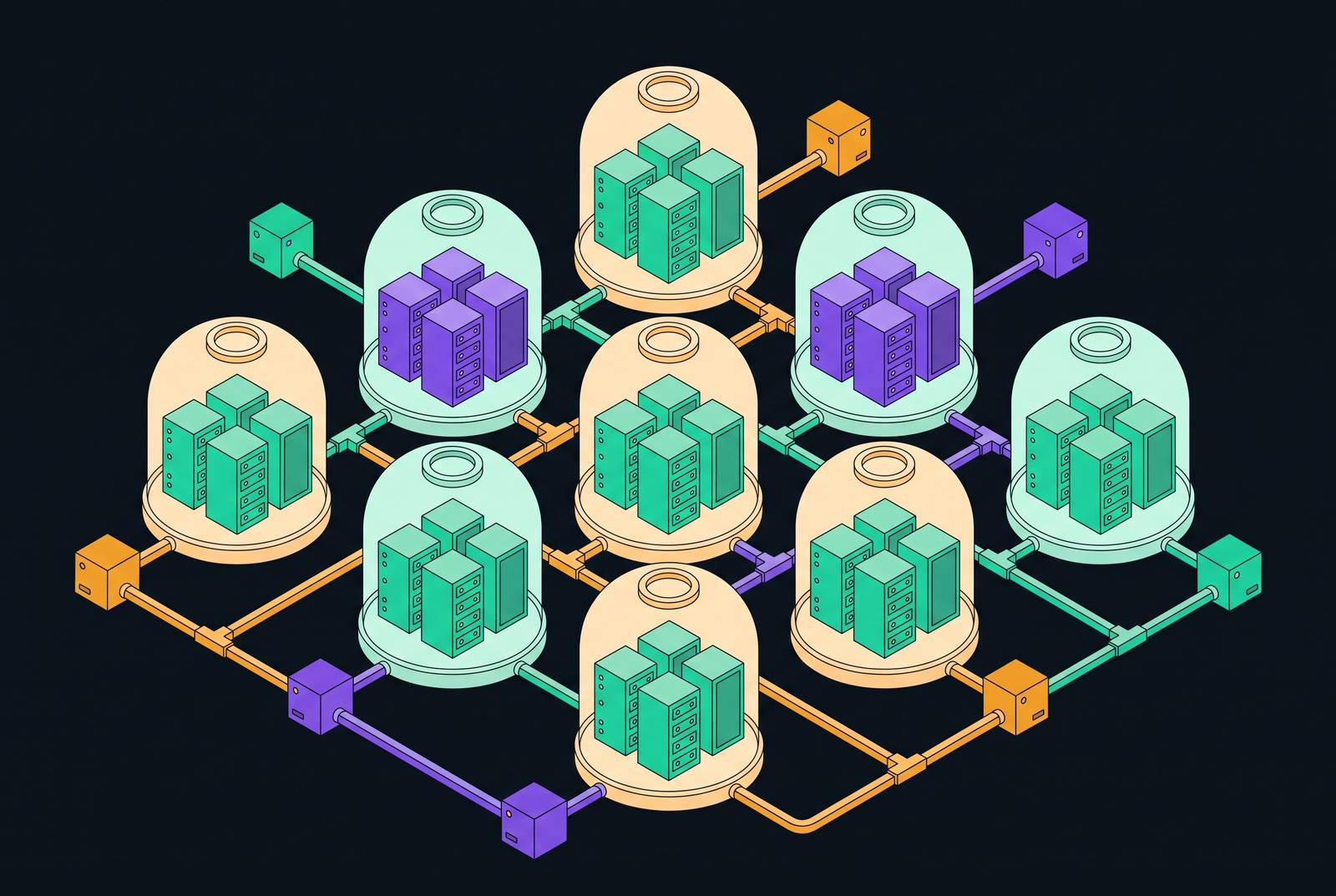
For integration testing against stateful APIs, run the real backend in an isolated environment and replace external dependencies with local, stateful simulators that start from known data. Test complete sequences of operations, assert the resulting state, and fail on unexpected external calls. Hermetic test environments for backend services require controlled replacement to make tests repeatable and honest about correctness.
What "hermetic" actually means for a backend test environment
A hermetic backend test environment produces results that depend only on the code and data explicitly given to it. Every external dependency is replaced by a controlled, local stand-in. Bazel’s hermeticity model establishes this principle for builds through a sandboxed execroot containing only declared inputs. Google’s “hermetic server” pattern extends it to integration tests by starting a real server binary on the test machine and injecting its external connections at runtime.
A test that poisons DNS can still pass if the application silently swallows the resulting error. A green result does not prove that the intended interaction happened or rule out an attempt to make an unexpected call. A useful test would fail if the property were broken. The correct model is replacement, with reachable stand-ins that journal calls, reject unmatched requests, and support the assertion that “zero unexpected calls were made.
Why shared staging environments are structurally incompatible with this property
Shared staging violates the requirement that a test control its inputs. It accumulates state while multiple teams change services, configuration, and data. Configuration drift can produce the “works in staging, breaks in production” scenario, while a half-deployed feature can corrupt another team’s fixtures. Separate release pipelines make this worse when they run against the same environment, because a regression in one service can block work on another.
Azure Chaos Studio’s experience shows why serialization inside one pipeline is insufficient. Even with stage-level serialization, real network conditions and cross-service regressions made shared-environment E2E tests untrustworthy. The team described local reproduction as 'spin up your own resource group and pray'. The uncontrolled inputs came from outside the individual pipeline, so ordering its own stages could not remove them.
Getting fresh data also means relying on shared resources. Perforce Delphix’s 2026 Test Data Management Report found that the overwhelming majority of organizations wait more than one business day for a fresh full production copy of test data, with a significant portion waiting weeks or months. These waits make it hard to set up realistic, isolated scenarios. The consequences include delayed releases, idle cloud resources, and production bugs that isolated tests could have caught.
How ephemeral, per-PR environments restore isolation at the infrastructure level
Ephemeral environments give each test context an environment to use and discard, so it has no shared infrastructure state. When a developer opens a pull request, CI builds the service and provisions its databases, services, and fresh data. Tests run against that environment, and results appear as PR annotations. The environment is destroyed on merge or close. This lifecycle makes a known baseline part of provisioning rather than something teams must recover from a shared deployment.
Azure Chaos Studio’s hermetic Aspire setup illustrates how to populate that environment without replacing the application itself. It runs real service binaries wired as they are in production, uses emulators for Cosmos and Storage, and supplies stubs for dependencies that cannot be emulated. These components are expressed as resources on the AppHost. Tests wait for real health checks, so readiness is an observed condition.
A fresh environment that calls live Stripe or GitHub APIs still relies on state outside it. Disposing of that environment does not make those calls repeatable. Ephemeral provisioning manages infrastructure creation and disposal, but the dependencies inside it still need controlled replacements.
Where stateless mocks fall short of true hermeticity
A stateless mock can replace live calls without fully testing that an integration works. It maps request patterns to canned responses and retains no memory between operations. A POST that creates a customer and a later GET can return objects that look consistent, but that consistency belongs to the fixture configuration. It does not demonstrate that the GET retrieved what the POST created.
The distinction becomes clearer with a payments API. A mock that returns the same balance after any deposits or withdrawals cannot catch errors in the logic that adds up those transactions. Request matching may constrain the shape of each call, but it cannot compare a later request with state produced by an earlier one. A recorded cassette has the same limitation because its responses remain frozen throughout the test’s actions. Recordings can also drift as the real API evolves.
Static mocks provide one response per endpoint, while conditional mocks vary responses with request shape and cover many error paths. Both are useful for unit tests that isolate a single code path. Integration tests instead need to establish that a sequence of calls produces the correct cumulative result, which requires persistent state.
How can you do integration testing against stateful APIs
Use a stateful simulator whose fidelity is measured against the API it replaces. Rystic publishes fidelity scores and verifies its simulators against the real API before every release, comparing responses to the same requests. That cadence matters because an untested stand-in can accumulate its own version of API behavior. Continuous verification makes fidelity an explicit criterion rather than an assumption, although a published score is not a claim of complete equivalence.
Stateful behavior supplies the causal link missing from canned responses. Creating a record changes what a later list or fetch returns, and deleting it changes those responses again. State transitions can also trigger webhook events, allowing tests to exercise handlers. Repeating requests then tests idempotency against the state built up so far, in place of another hardcoded success.
The starting state must be controlled as carefully as the transitions. Realistic pre-seeded data, which comes with options such as Rystic’s local simulators, lets tests start from a known baseline without waiting for shared data to be refreshed. Each isolated run can then exercise the behavior under examination with the initial world already constructed. Combined with local execution, this gives tests control over third-party dependencies without live credentials or rate limits. Statefulness makes the sequence meaningful, while a repeatable baseline makes its result reproducible.
How the layers compose into a working hermetic CI pipeline
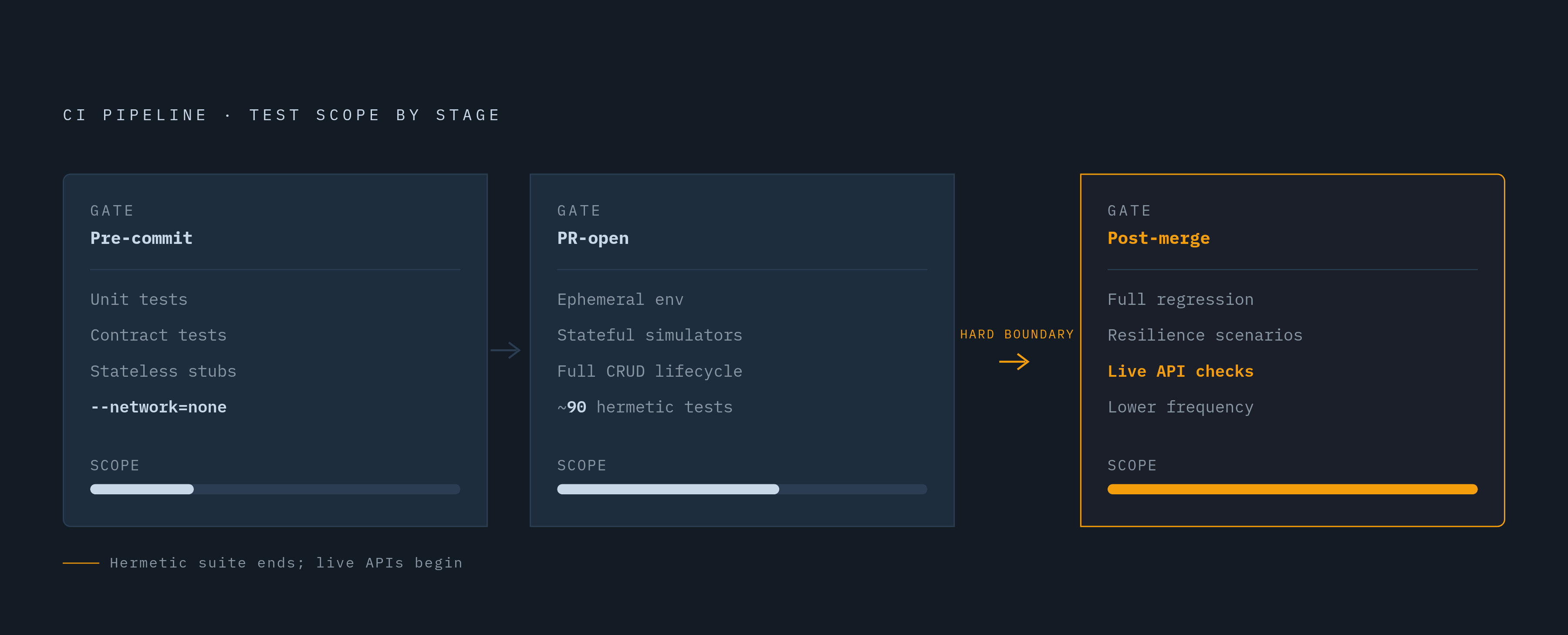
The network layer blocks egress, the environment layer removes shared state, and the simulator layer makes dependencies behave realistically. At pre-commit, unit and contract tests can use stateless stubs with container networking disabled through --network=none or an equivalent control. These checks keep narrow feedback fast without pretending to validate full integration behavior.
At PR-open, set up the isolated environment and send third-party API calls to stateful simulators. Integration tests should exercise the create-read-update-delete lifecycle and assert the resulting state. Publish results as PR annotations and keep merging blocked until every check passes. Azure Chaos Studio reports roughly 90 hermetic tests running per PR, with scenario coverage including zone-outage, identity-outage, DNS-failure, and geo-replication-failure flows. Its model shows how integration checks can exercise a real service graph while remaining reproducible in CI.
After merge, run the full regression suite and resilience scenarios against the same controlled dependencies. Keep live API checks in a dedicated, lower-frequency stage because those checks serve a different purpose and are not hermetic. Mixing them into the isolated suite would weaken its guarantee. Finally, assert that no unmatched or unexpected external calls were made, so a new live call causes a visible failure even if the code handles the network error.
Applying hermetic simulation to AI agents that call external APIs
Agents need the same controlled dependencies, but their tests must distinguish plausible language from correct tool use. An agent can produce coherent text while sending malformed JSON or selecting the wrong endpoint. The test therefore needs to check which API calls were made and what they did. Multi-turn workflows need state because a record created in one turn must still be there when a later turn refers to it. Prompt injection adds another failure mode when an input induces unauthorized calls, data extraction, or record modification.
Stripe’s production “Minions” deployment provides a concrete example of containment around an agent. Its unattended coding agents run in disposable devboxes with no internet access and no production data. Context is fetched up front, and the agents receive a small curated toolset.
For reinforcement learning and agent evaluation, runs must be repeatable across episodes and when they run in parallel. The environment needs deterministic behavior, state that can be controlled, and room to scale across thousands of containers. A local simulator that resets between episodes also gives integration tests of agent tool use the starting state they need. Rystic’s stateful simulators support this use case through local execution without credentials and resettable state. The simulator controls the API environment, allowing evaluation to focus on the agent’s decisions and their consequences.
Specific fidelity concerns when simulating Stripe, PayPal, and GitHub
Stripe supports up to five general isolated sandbox environments, plus a test mode sandbox outside that limit, and its CLI can trigger webhook events directly. Stripe’s documentation states that event order is not guaranteed, duplicate deliveries can occur, and undelivered events are retried for up to three days. Those semantics make webhook idempotency a required test property. Stripe Sigma is available in sandboxes for custom report validation, but IC+ pricing cannot be tested there, so sandbox success does not establish full production equivalence.
PayPal’s sandbox supports virtual buyer and seller accounts for payments, refunds, and disputes. Its webhook simulator serves a narrower purpose. PayPal documents that simulated events are for demonstration only, are not associated with an app, and do not appear in the dashboard event viewer. PayPal also retries failed webhook deliveries multiple times over three days. A demonstration event therefore cannot substitute for testing how an application handles state changes and repeated delivery, and continuous fidelity verification is important for a simulator standing in for that behavior.
GitHub tests need workflow state: a test that opens a PR must be able to fetch it, request review, and then merge or close it in sequence. Independent canned responses cannot establish that each step produced the state required by the next. GitHub is among the APIs supported by Rystic, but support alone is not the evaluation criterion. For any simulator, the relevant criteria are the state transitions and delivery semantics of the actual workflow, plus clearly represented limits on what it can reproduce.
Fault injection as a first-class concern inside the hermetic environment
Correctness under normal responses is only part of integration behavior. The same controlled environment should exercise failures because resilience also depends on sequences of calls and changes in state. Simulator-level controls for 429s, 503s, and delayed responses make those scenarios repeatable without placing a chaos layer over a live API.
Different injection layers answer different questions. At the unit layer, thrown exceptions, mock error responses, and degraded-mode feature flags test how particular code paths behave. At the protocol layer, malformed HTTP responses, incorrect status codes, truncated payloads, and contract violations test how consumers handle upstream failures. At the network layer, Toxiproxy can introduce latency, connection drops, and bandwidth limits within CI. These are complementary choices.
Azure Chaos Studio’s scenario tests show how failures can be driven through the real service graph. Its zone-outage scenario exercises the full LRO lifecycle from request through orchestration, while identity-outage tests data-plane behavior when an identity provider fails. The value comes from reproducing those failures inside the hermetic environment, where the application and dependency state remain controlled. The same principle applies to agent resilience, with a predefined fault schedule making recovery behavior testable. A complete hermetic environment controls not only what dependencies return when they work, but also how they fail.