Sequencing Integration Tests When API Operations Have Side Effects
Test a complete workflow's state changes, not just individual API responses.
Integration testing against stateful APIs requires an isolated, stateful environment in which each call changes what later calls can observe. “Sequencing Integration Tests When API Operations Have Side Effects” argues that the unit of proof is the workflow. Without hitting production, teams can use a stateful simulator to verify each operation’s response, its side effects, and the preconditions it leaves for the next step.
Why the response body is the wrong thing to assert on
A pipeline mocks POST /v1/payment_intents, asserts a 200, and lets the merge through. But the handler never saved the PaymentIntent ID. When the webhook path runs, it reads undefined. The missing assertion concerns what the handler persisted.
That distinction applies wherever an API writes a record, places a message on a queue, or triggers a downstream call. A response assertion remains useful, but it cannot establish that these effects happened correctly. The handoff is where isolated checks lose reach. An e-commerce flow can have a working inventory check, pricing engine, payment processor, shipping calculator, and notification service, yet fail because payment data arrives in a format the inventory system cannot understand. Judging the suite by its passing tests conceals that gap, while judging it by the staging and production failures it catches exposes it.
How side effects create state-dependency chains
A search journey spans query input, geocoding, aggregation, ranking, and pagination. Each step needs what the step before it produced. The sequence is therefore not an arbitrary arrangement of endpoint checks. It follows dependencies imposed by the workflow itself. If one link produces the wrong state, later operations begin from a false precondition even when their individual responses look valid.
If tests share one global fake state, a mutation in test A can change the starting conditions for test B. The resulting failure is real within that run, but difficult to reproduce when execution order changes. Order alone is therefore not enough to control the chain. Teams should start with a dependency map that names the entry point, the internal and external dependencies, the response and side-effect assertions, and the expected failure modes. The workflow, rather than the route file, defines the test’s scope.
What stateless mocks cannot tell you about a sequence
A stateless mock gives the same configured response to the same request and has no memory of earlier actions. That makes it useful for a single interaction but insufficient for proving a lifecycle. Consider a customer posted in step 1 and a subscription returned in step 3. A hardcoded customer object and a hardcoded subscription object can appear consistent even if nothing connected them.
Adding scripts and mutable variables can narrow that gap, but it introduces another boundary. Once business rules accumulate in the mock, the test double approaches a parallel implementation of the service. The recommended move at that point is usually to run a real instance against a seeded database instead. Not every test needs that level of behavior. Injected function or client fakes work well for fast decision logic, such as choosing a shipping tier or mapping a status code, because those tests check which branch the code takes without needing state to build up.
What a stateful simulator actually does differently
A stateful simulator makes later responses depend on earlier requests. A POST stores a resource, the next GET returns it, a list endpoint includes it, and a PATCH updates it. State machines allow only valid transitions, and webhook events fire when state changes. A mock uses predefined responses to stand in for the interface, while a simulator uses stored records and business logic to act like the service in an isolated environment.
That memory must stop at the test boundary. The recommended design gives each test a scenario or account namespace, exposes reset endpoints only in isolated environments, and cleans state in finally hooks. Immutable scenario definitions combined with per-test runtime state prevent parallel tests from altering one another’s preconditions. Realistic pre-seeded data also gives the sequence a world to start from. An empty sandbox forces every test to construct its own setup and can obscure paths that appear only when records already exist.
How to write integration tests when API operation order matters
When teams build these sequences, each named step should name the operation, assert its response, and assert its side effect in a separate check. In the payment flow, checking the payment-intent response is only the first assertion. The next checks whether the handler stored the PaymentIntent ID. Only then does the webhook path have the precondition it needs. Separating these checks lets a failure point to the broken transition rather than merely to the final operation that could no longer proceed.
The recommended construction starts with the payment system and adds dependencies incrementally. Once the payment transitions have been tested, the sequence adds inventory management and then the shipping module. Each addition makes another handoff visible before the next dependency complicates diagnosis. The environment must expose the resulting state. If it cannot show what was written, updated, or queued, the test cannot establish whether the next step began correctly.
Coverage follows failure cost. Authentication, payment, and write operations are critical flows that block merges, while core reads and searches run frequently and analytics or optional enrichments run on schedule. In the running payment example, this places the payment lifecycle in the merge-blocking group. It also explains why a response-only payment check cannot substitute for the sequence.
Where simulator fidelity determines whether the sequence is trustworthy
A sequence can be carefully designed and still prove the wrong behavior if its simulator has drifted from the provider. Fixtures may remain untouched while field optionality, pagination behavior, authentication headers, or error formats change. The suite can stay green throughout that drift. Spec-derived mocks have the same dependence on their source, because an incomplete or stale OpenAPI document produces an incomplete or stale representation.
Stripe provides a concrete example at the webhook boundary. Its api_version field identifies the version used to render events for that endpoint. A null value follows the account default, so upgrading the account can change webhook payloads without a webhook-code deployment. The payment sequence may then test an old event structure against what the handler expects today. Continuous verification against the real API is therefore a required part of maintaining the environment.
Fault injection as a required step in any honest sequence
A happy-path sequence proves how the code works only when everything goes as planned. The sequence must include faults and an assertion that the next step sees the correct error-handling state, with a check for silent corruption. Relevant cases include slow responses, intermittent 502s, duplicate webhooks, stale pagination cursors, malformed payloads, partial data, and connection drops. Each can interrupt a different link between an operation and the state its successor expects.
A real API cannot reliably produce a 500, timeout, or malformed payload on cue, and live calls can charge a card, send an SMS, or write to a shared database. Their latency also works against a fast CI pipeline. Deterministic injection separates those consequences from the test. In a stateful simulator, the fault can occur at a named step while the test still observes the state that follows it.
Webhook scenarios must also match how the provider delivers webhooks. PayPal retries failed deliveries up to 25 times over an extended period, whereas GitHub does not automatically redeliver failed webhook deliveries. GitHub provides redelivery through its delivery view and the REST API operation POST .../deliveries/{delivery_id}/attempts. For webhook resilience, the recommended tests model the provider as stateful, sign callbacks over the exact raw bytes, and exercise duplicate, delayed, out-of-order, invalid-signature, unknown-type, and retry cases.
Verification behavior belongs in that model too. PayPal supports a postback method using its transmission headers, the webhook ID, and the event, or local cryptographic verification using the certificate supplied in the paypal-cert-url header. Testing only a generic callback response omits that boundary. The sequence must test how the provider verifies webhooks and recovers from failed deliveries without waiting for a live delivery to fail.
How CI gates turn sequence results into merge signals
A coding agent can change an integration handler, pass the existing mocks, and move on without exercising the affected lifecycle. Production then encounters the path that CI never tested. A runnable stateful proof closes that specific gap. As a CI step, it returns a binary exit code and blocks the PR when any named workflow step fails.
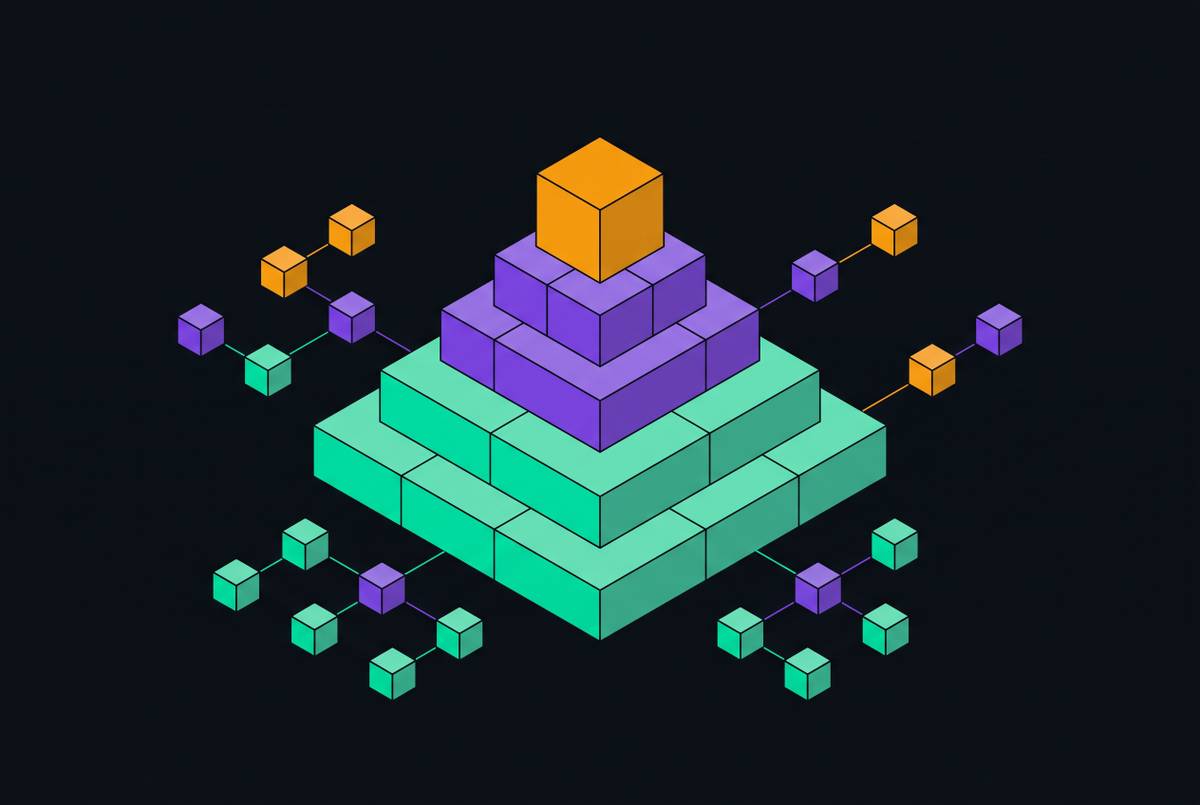
Fast stateless checks still belong on every PR. Stateful workflow sequences must pass before merge or deploy and sit between narrow unit checks and slower end-to-end journeys. For API-heavy applications, the recommended pyramid assigns 30% of the suite to integration tests. That allocation responds to handoff risk rather than treating speed as the only measure of test value. Local or containerized simulators support this placement by running parallel jobs without live credentials or API quota, properties that live sandboxes and recorded cassettes cannot reliably provide.
Agent tool-use introduces state-dependency chains the classical approach doesn't cover
AgentChaos found that silent corruptions from API faults could propagate through an agent chain undetected. That finding exposes the weakness of judging an agent by its final language alone. An agent can produce coherent text while sending malformed JSON to a payment API. Tool correctness is a separate concern from fluency. Testing must examine parameter extraction, endpoint selection, and response parsing, as well as the state produced across calls.
An LLM caller makes the dependency chain harder to isolate because execution is non-deterministic, tool use spans multiple steps, and external data changes between runs. In the recommended layer model, the LLM is another external dependency. A deterministic mock returns fixed JSON in place of the model call, while the agent’s routing and parsing logic runs against a stateful simulator. This separates integration behavior from model variability without discarding the workflow’s memory. The same environment requirements extend to RL training, where consistent reward signals across thousands of parallel rollouts require deterministic, stateful, horizontally scalable simulation rather than a live API’s rate limits, variable latency, and shared state.
Building a sequencing discipline that holds across the stack
The practices form one discipline because they address different ways a precondition can become untrustworthy. CI then enforces the resulting proof. The environment must support all of these properties together for a passing workflow to justify confidence in the integration.
That standard excludes stateless mocks as the primary integration substrate, without excluding their use for decision logic. It also limits the value of recorded cassettes that need a live capture run to change, empty sandboxes that rebuild every precondition, and live APIs that introduce quota consumption and non-determinism into CI. Endpoint coverage alone cannot resolve these weaknesses. The organizational signal is whether the suite catches failures the team has actually seen in staging and production by exercising the workflows the business depends on, in their real order, against state that accumulates as it does in production.